
Capacitance marking decoder
SMD capacitor code calculator
Decode common three-digit capacitor value codes, low-value R-decimal markings and direct pF, nF or µF notation. The calculator also interprets common F, G, J, K and M capacitance-tolerance suffixes and shows the result across practical engineering units.
Decoded capacitance
Capacitance
100 nF
100,000 pF
Detected system
3-digit pF code
Value code: 104
Code basis
10
10^4 pF
Tolerance
±10%
K = ±10%
Value code decoded
10 × 10^4 pF. Treat any remaining voltage, dielectric, case or date characters as series-specific until confirmed in the manufacturer datasheet.
Code and unit map
See how the printed value maps to the same capacitance in common engineering units.
Base convention: capacitance code in pF
Printed marking
10 × 10^4 pF
- Picofarads
- 100,000 pF
- Nanofarads
- 100 nF
- Microfarads
- 0.1 µF
How to decode a capacitor value marking
Separate the capacitance value field from any tolerance or manufacturer-specific characters before selecting a replacement part.
- 01
Record the complete visible marking
Preserve character order, capitalization, polarity stripes and line breaks. A multi-line marking may combine capacitance, voltage, date and lot information.
- 02
Identify the value-code scheme
Use the three-digit pF convention for codes such as 104, R-decimal pF notation for values such as 1R4, or direct p/n/u notation when a unit letter appears in the value.
- 03
Check the optional tolerance suffix
Common suffixes include F, G, J, K and M, but the available tolerances depend on dielectric and product series.
- 04
Confirm the complete capacitor specification
Match dielectric, rated voltage, package, polarity, ESR, temperature behavior and DC-bias performance against the exact manufacturer data.
Common capacitance marking relationships
The numerical capacitance convention uses picofarads as its base unit, while direct notation places the unit letter at the decimal position or after the number.
Three-digit capacitance code
AB C → AB × 10^C pF
Low-value R notation
1R4 → 1.4 pF
Direct unit notation
4n7 → 4.7 nF; 100n → 100 nF; 1u0 → 1.0 µF
Capacitance unit relationship
1 µF = 1,000 nF = 1,000,000 pF
Common tolerance example
104K → 100 nF with K = ±10%
For a three-digit code, the first two digits are significant and the third digit is the number of zeros added in picofarads. A trailing tolerance letter is not part of the capacitance value. Direct unit notation uses p, n or µ/u to indicate the unit and often the decimal position. These rules decode the capacitance field only, not a complete manufacturer part number.
Many small MLCC packages carry no value marking, and molded tantalum, polymer, film or specialty capacitors can use series-specific voltage, polarity, date and lot codes. Never infer rated voltage, dielectric, polarity or safe substitution from the decoded capacitance alone.
Checks before replacing an SMD capacitor
Capacitance is only one selection parameter; real behavior can differ substantially between parts with the same nominal value.
Identify capacitor technology and polarity
MLCCs are normally non-polarized, while tantalum, polymer and electrolytic parts may be polarized. Reversing a polarized capacitor can cause failure.
Verify the rated and applied voltage
Voltage markings are not universal. Confirm the exact series and apply the manufacturer’s derating guidance where required.
Match dielectric and temperature behavior
C0G, X7R, X5R and other dielectrics differ in stability, temperature range and voltage dependence.
Account for DC-bias capacitance loss
High-capacitance MLCCs can deliver substantially less effective capacitance under DC voltage than their zero-bias nominal value.
Confirm case size, ESR and ripple requirements
Physical size, termination, ESR, ripple current, surge behavior and mechanical robustness can be circuit-critical.
SMD capacitor code questions
What does 104 mean on a capacitor?
Using the common three-digit pF convention, 10 × 10⁴ pF equals 100,000 pF, 100 nF or 0.1 µF.
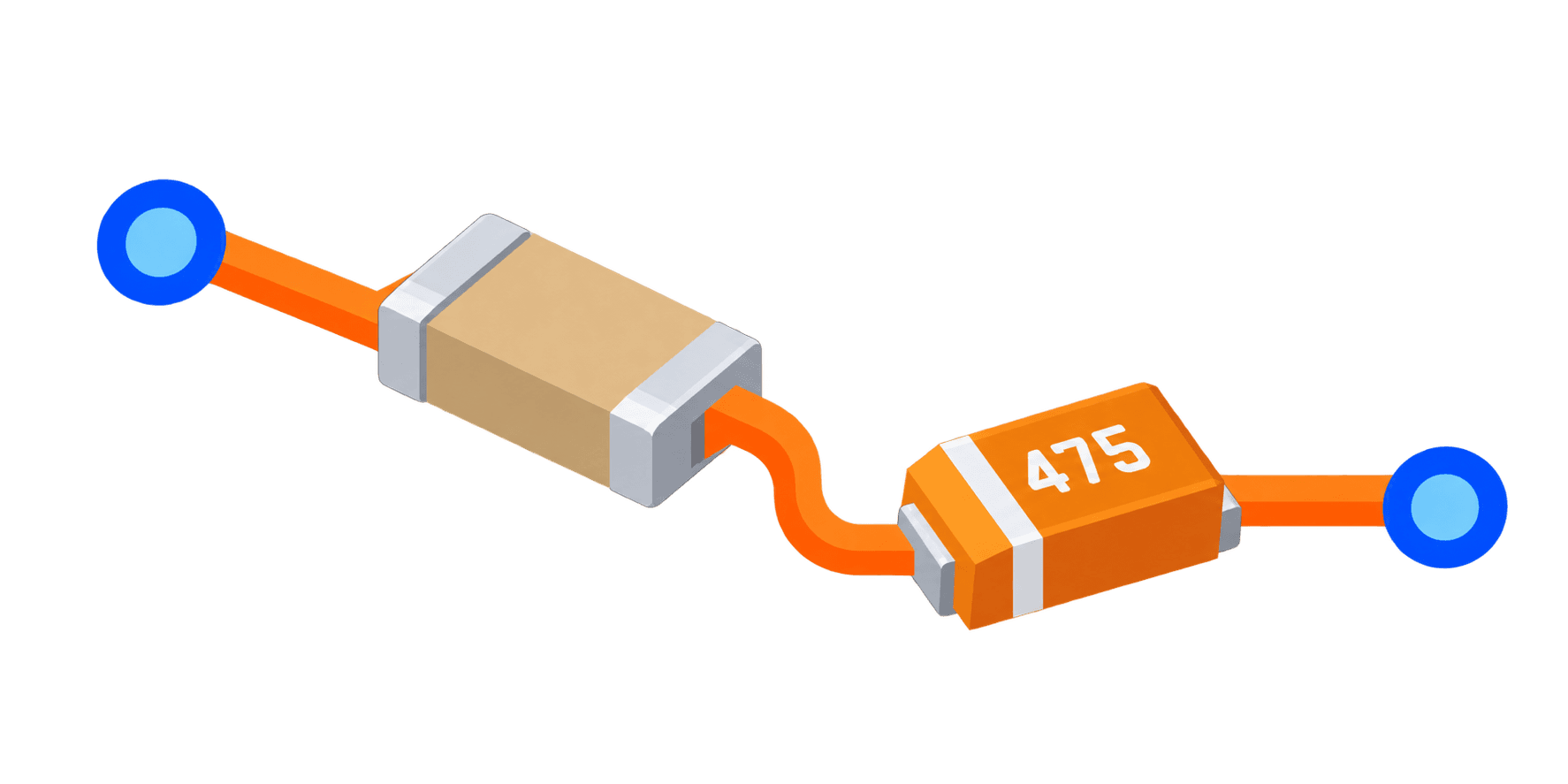
What does 475 mean on a capacitor?
The code represents 47 × 10⁵ pF, which is 4,700,000 pF or 4.7 µF.
What do J, K and M mean after the capacitance code?
They commonly indicate capacitance tolerance: J is ±5%, K is ±10% and M is ±20%. Availability and meaning should still be checked against the series datasheet.
Why is an MLCC capacitor unmarked?
Very small ceramic chip capacitors often have no practical space for a legible value code. Use the BOM, reel label, placement data or original documentation instead of visual guessing.
Can this code identify the capacitor voltage rating?
Not reliably. Rated-voltage codes are often manufacturer- and series-specific, and many value markings do not include voltage information at all.
Related engineering tools

Reactance calculator
Use the decoded capacitance to calculate ideal capacitive reactance at a selected frequency.
Open resource
Time constant calculator
Use the decoded capacitance in RC transient calculations.
Open resource
Capacitor safety discharge calculator
Estimate stored energy, remaining voltage and passive discharge time.
Open resourceAll engineering tools
Browse Xindustra’s electrical, timing, component and RF calculators.
Open resource