
Component marking decoder
SMD resistor code calculator
Decode common surface-mount resistor markings including three-digit and four-digit numeric codes, R-decimal notation, EIA-96 lookup codes and zero-ohm jumpers. The result separates the significant-value field from the multiplier so the marking can be checked at a glance.
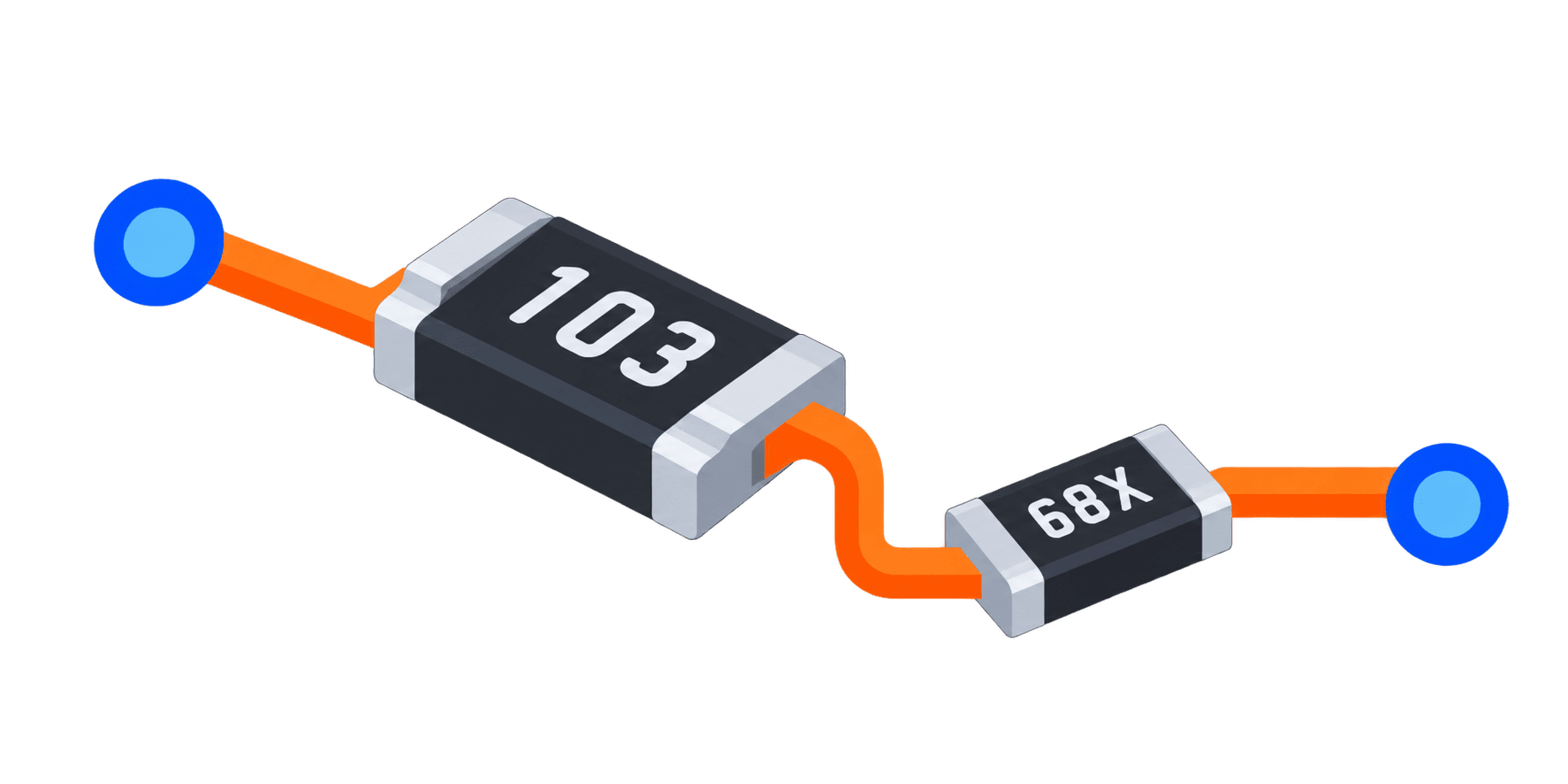
Decoded resistance
Resistance
10 kΩ
10,000 Ω
Detected system
3-digit code
Normalized marking: 103
Code basis
10
10^3 = ×1,000
Tolerance guidance
Often 5%
Three-digit markings are commonly associated with E24 / 5% parts.
Code decoded
10 × 10^3 Ω. Confirm the package marking convention and electrical ratings in the manufacturer datasheet before substitution.
How this marking is read
The package view separates the value field from the multiplier or decimal marker.
- Value field
- 10
- Multiplier / decimal
- 10^3 = ×1,000
- Decoded expression
- 10 × 10^3 Ω
How to decode an SMD resistor marking
Read the complete top marking, select a code system when known, and then verify the result against the exact resistor series.
- 01
Read the marking in its printed order
Record every digit and letter. Distinguish the letter R from a damaged digit and note whether the package has any orientation mark.
- 02
Choose the code system
Use automatic detection for common markings, or select 3-digit, 4-digit or EIA-96 when the manufacturer documentation identifies the scheme.
- 03
Review the value and multiplier
Check how the significant digits, decimal marker or EIA-96 table index produce the displayed resistance.
- 04
Confirm the part before replacement
Verify tolerance, power rating, working voltage, temperature coefficient, package size and special construction in the datasheet.
SMD resistor marking rules
The same number of printed characters can represent different conventions, so the code structure matters as much as the characters themselves.
Three-digit numeric code
AB C → AB × 10^C Ω
Four-digit numeric code
ABC D → ABC × 10^D Ω
R-decimal notation
Replace R with the decimal point: 4R7 → 4.7 Ω
EIA-96 code
Table value for 01–96 × letter multiplier
Zero-ohm jumper
0, 000 or 0000 → nominally 0 Ω
For standard numeric markings, the last digit is a base-10 exponent rather than another significant digit. EIA-96 instead uses its first two digits as a lookup-table index and a final letter as the multiplier. The calculator accepts the commonly published alternate multiplier letters R, S and H, but manufacturer conventions should take precedence for an ambiguous code.
A decoded resistance does not identify the complete part. Small packages may be unmarked, manufacturers may use proprietary or series-specific codes, and current-sense, fusible, anti-surge or resistor-array parts can require different interpretation. Confirm the exact series before procurement or substitution.
Checks before replacing a marked SMD resistor
Use the decoded resistance as an identification clue, then validate the component and circuit requirements.
Check character orientation
Digits such as 6 and 9 can be ambiguous on loose components. Use board context, package marks and the original documentation to confirm orientation.
Match the physical package
Case size affects power, voltage, pulse and thermal performance even when two parts have the same resistance marking.
Do not infer tolerance from the value alone
Three- and four-character conventions often correlate with tolerance classes, but the series datasheet is the authoritative source.
Verify voltage, power and pulse ratings
A resistance match is insufficient when the original part carries surge, high-voltage, current-sense or safety-related requirements.
Measure with circuit effects in mind
An in-circuit meter reading can include parallel paths. Isolate the part when necessary and follow safe de-energization procedures.
SMD resistor code questions
What does 103 mean on an SMD resistor?
In the common three-digit system, 10 is the significant value and 3 is the power-of-ten multiplier, giving 10 × 10³ Ω or 10 kΩ.
What does 1002 mean on an SMD resistor?
In the common four-digit system, 100 is the significant value and 2 is the multiplier, giving 100 × 10² Ω or 10 kΩ.
What does R mean in a resistor marking?
R commonly takes the place of the decimal point. For example, 4R7 means 4.7 Ω and R47 means 0.47 Ω.
How is an EIA-96 marking different?
Its first two digits select one of 96 base values from a lookup table; the last letter supplies the multiplier. For example, 68X maps 68 to 499 and X to ×0.1, giving 49.9 Ω.
Why does an SMD resistor have no printed code?
Very small packages may not have room for a legible value marking, and marking policies vary by series. Use the bill of materials, board documentation, packaging label or manufacturer data.
Related engineering tools

Voltage divider calculator
Use decoded resistor values in an unloaded or loaded divider calculation.
Open resource
Pi attenuator calculator
Calculate ideal resistor values for a symmetrical matched attenuator.
Open resource
Time constant calculator
Use decoded resistor values in RC and RL transient calculations.
Open resourceAll engineering tools
Browse Xindustra’s electrical, timing, component and RF calculators.
Open resource